AI Model Customization: The New Frontier for Enterprise Intelligence
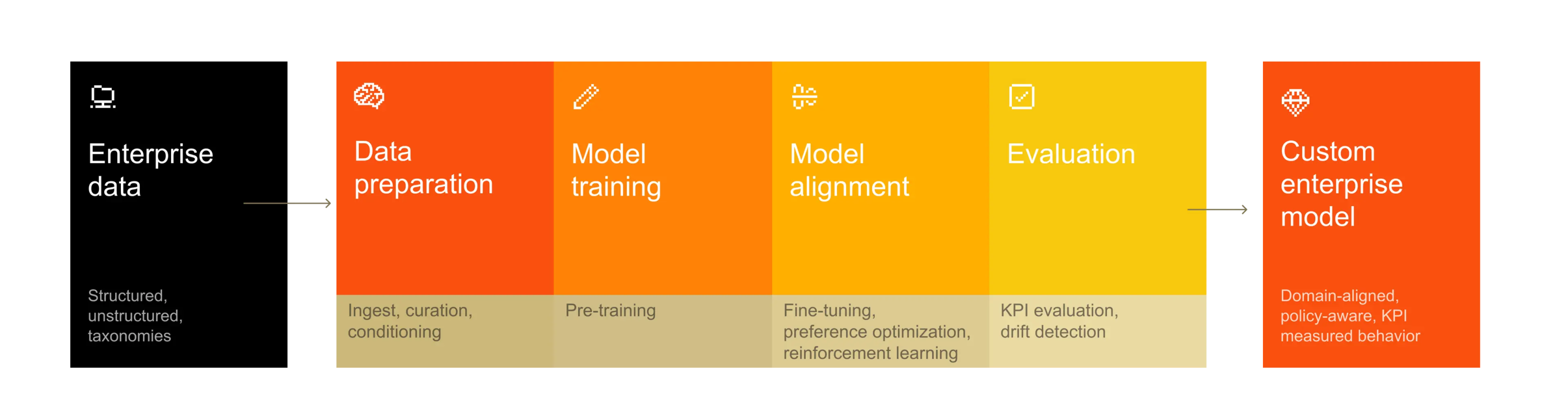
Image credit: Imagem: MIT Technology Review
The Evolution of Large Language Models
In the early years of generative artificial intelligence, we witnessed impressive leaps in the reasoning and coding capabilities of large language models (LLMs). Each new iteration brought improvements that seemed to push the boundaries of what was possible, often delivering tenfold performance gains over their predecessors. This initial phase, marked by innovations like GPT-3 and its successors, laid the groundwork for the AI revolution we are experiencing today.
However, this exponential growth curve for general-purpose LLMs appears to be flattening. Recent improvements, while still significant, tend to be incremental rather than revolutionary. This suggests that the focus of innovation is shifting away from creating 'one-size-fits-all' models towards a more targeted and specialized approach.
The Rise of Domain-Specialized Intelligence
The true frontier for significant AI advancements now lies in specialized intelligence and model customization. Instead of attempting to build a model that is good at everything, organizations are discovering that the greatest gains come from adapting LLMs to specific domains, integrating them deeply with internal data and processes. This approach allows models to understand the unique nuances, terminology, and context of a business or industry, resulting in performance far superior to that of generic models.
When an AI model is 'fused' with an organization's proprietary knowledge – whether through fine-tuning, retrieval-augmented generation (RAG), or other customization techniques – it can unlock unprecedented value. This means that for many businesses, the path to AI innovation is no longer about waiting for the next super-powerful LLM, but rather investing in adapting and integrating existing models to their specific needs. To explore various options, you can compare AI tools [blocked] available in the market.
Architectural Imperative for Enterprises
MIT Technology Review highlights that this shift is an 'architectural imperative' for businesses. It's not just an option but a strategic necessity to maintain competitiveness. Organizations that can seamlessly integrate customized AI into their operations – from supply chain optimization to customer service and product development – will be the ones to reap the greatest benefits. This demands a mindset shift, from passive consumption of generic models to active, strategic development of tailored AI solutions.
Companies like OpenAI, with their APIs enabling model fine-tuning, and Google, with its enterprise AI platforms, are facilitating this transition by providing the necessary tools for customization. The ability to build AI agents that act as domain experts, with access to corporate data and the capacity to interact with internal systems, is the next major step. Data security and privacy are, of course, paramount considerations in this process, requiring robust architectures and regulatory compliance, as detailed in reports on AI safety research.
Analysis and Future Implications
The most significant implication of this shift is that competitive advantage in AI will not solely come from possessing the most powerful models, but from the ability to effectively customize and integrate them. This democratizes access to advanced AI capabilities, allowing businesses of all sizes to innovate, provided they invest in the right infrastructure and talent. The focus moves towards prompt engineering, fine-tuning with proprietary data, and creating AI architectures that seamlessly fit into existing workflows.
This trend also underscores the importance of data governance and an organization's capability to prepare and manage large volumes of internal information. Without clean, well-structured data, model customization becomes a significant challenge. It's a reminder that AI is only as good as the data that feeds it. Businesses investing in enterprise AI [blocked] should consider customization a core pillar of their strategy.
Why It Matters
The shift towards AI model customization is not just a technological evolution but a redefinition of enterprise strategy. It empowers businesses to transform generic models into highly specific and effective intelligence tools, generating competitive advantages that 'off-the-shelf' models cannot provide. Ignoring this trend means missing the opportunity to unlock significant value and fall behind in an increasingly AI-driven business landscape.
This article was inspired by content originally published on MIT Technology Review by Barry Conklin. AI Pulse rewrites and expands AI news with additional analysis and context.
AI Pulse Editorial
Editorial team specialized in artificial intelligence and technology. AI Pulse is a publication dedicated to covering the latest news, trends, and analysis from the world of AI.



Comments (0)
Log in to comment
Log in to commentNo comments yet. Be the first to share your thoughts!