DeepSeek-Prover-V2: AI Elevates Mathematical Theorem Proving
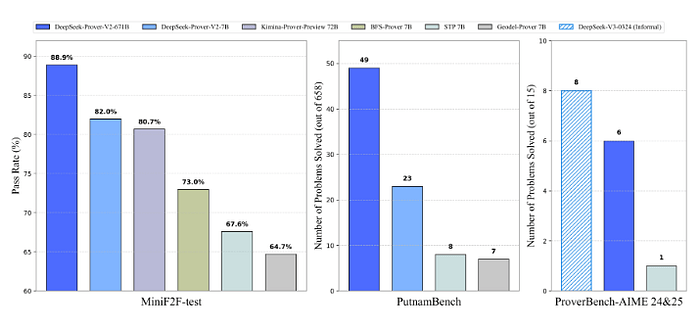
Image credit: Imagem: Synced AI
DeepSeek AI, a prominent artificial intelligence research firm, recently announced the release of DeepSeek-Prover-V2. This new open-source large language model (LLM) is specifically optimized for mathematical theorem proving within the Lean 4 environment, promising to revolutionize how AI interacts with formal logic and mathematics. The initiative represents a bold step in integrating advanced reasoning capabilities into AI systems.
The Challenge of AI-Powered Theorem Proving
Automated theorem proving has been a long-standing goal in computer science and artificial intelligence. It involves creating systems capable of verifying the validity of mathematical or logical statements, often a complex and time-consuming process even for human experts. The formal structure of languages like Lean 4 offers fertile ground for AI, but also imposes stringent requirements for precision and logical consistency. Previous models, while promising, often struggled with the depth and complexity required to solve high-level mathematical problems.
DeepSeek-Prover-V2: A Novel Approach
DeepSeek-Prover-V2 distinguishes itself through its innovative methodology. Instead of a linear approach, the model employs a recursive proof search strategy. This means it can break down complex problems into manageable sub-problems, solving them iteratively until a complete proof is constructed. This hierarchical reasoning capability is crucial for navigating the vast search space in mathematical proofs.
Training for the model was enhanced by leveraging data generated by DeepSeek-V3, a more robust language model, and refined through reinforcement learning techniques. This combination allows Prover-V2 to learn from its own mistakes and optimize its search strategies over time. The results are striking: DeepSeek-Prover-V2 achieved superior performance on the MiniF2F benchmark, a challenging dataset for Lean 4 theorem proving, significantly outperforming prior models, as detailed in DeepSeek AI's official announcement. This advancement highlights the potential of AI in rigorous logical reasoning, echoing the progress seen in other AI research areas like those discussed in recent MIT research on AI capabilities.
Implications for Research and Applications
The launch of DeepSeek-Prover-V2 has profound implications for various fields. In mathematical research, it could accelerate the discovery of new proofs and the verification of complex theorems, potentially paving the way for breakthroughs that would be infeasible with human effort alone. For software engineering, formal verification can ensure the correctness of critical systems, from security algorithms to blockchain smart contracts. The open-source nature of the model further benefits the community, as it can be adapted and enhanced by researchers worldwide, fostering collaborative innovation. For those interested in the broader landscape of AI tools, exploring options can be done by using our compare AI tools [blocked].
This breakthrough also underscores the increasing capability of LLMs to transcend text generation and engage in symbolic reasoning tasks. It's a clear example of how enterprise AI [blocked] is evolving to solve problems that demand not just data analysis but also deep understanding and logic. The continued development in this area, including projects like OpenAI's work on AI safety and alignment, as referenced in their research initiatives, further solidifies the importance of robust AI reasoning.
Why It Matters
DeepSeek-Prover-V2 represents a significant milestone in the convergence of artificial intelligence and formal reasoning. By demonstrating an AI's ability to construct complex mathematical proofs with high precision, it not only validates the potential of LLMs in logical domains but also opens new frontiers for mathematical research, software verification, and the development of trustworthy AI. This advancement can accelerate knowledge discovery and the creation of more robust and secure systems across various industries, from academia to technology.
This article was inspired by content originally published on Synced AI by Synced. AI Pulse rewrites and expands AI news with additional analysis and context.
AI Pulse Editorial
Editorial team specialized in artificial intelligence and technology. AI Pulse is a publication dedicated to covering the latest news, trends, and analysis from the world of AI.